Side-by-Side Tao Te Ching Translation Reader
Put the Chinese, a close translation and a word gloss next to each other, and you can see what any English version of a chapter adds.
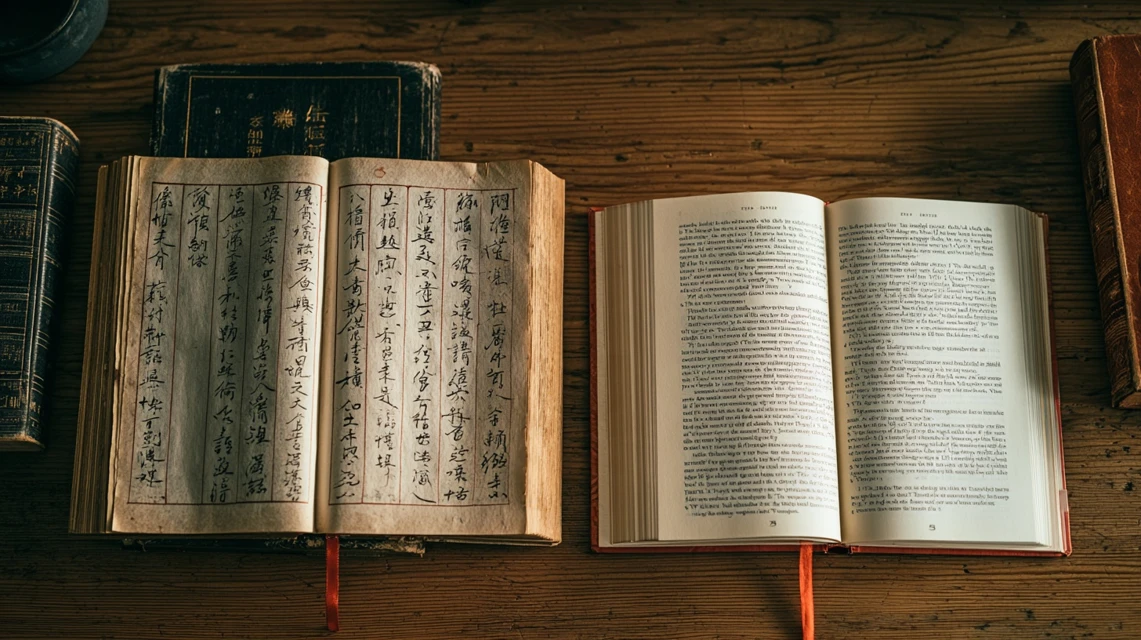

Side-by-side reading means setting the Chinese text, a close translation and your own notes in parallel, so you can tell what is in the original and what the translator brought. On this page you can do that for all 81 chapters with the public domain Chinese text and James Legge's 1891 translation, plus a word-by-word gloss for chapters 1 and 11.
It works best for checking a chapter that a looser translation made you curious about. It won't teach you classical Chinese, and it can't show modern translations, which are in copyright.
What each column shows
- Chinese original
- A received text of the Tao Te Ching in traditional characters (Project Gutenberg eBook #7337). The received text is the version passed down through later Chinese editions; the oldest manuscripts, discussed below, differ from it in places.
- James Legge, 1891
- A literal translation by the Scottish sinologist who became Oxford's first professor of Chinese. Legge puts the words he added in round brackets, which makes his choices easy to spot.
- Word-by-word gloss
- One or two English words per character, in Chinese word order, with slashes between units. It has no grammar on purpose.
- Your translation
- Keep your own copy open beside the screen and use the reader to check it.
How to read a chapter in four steps
- Read the gloss line by line and note the few words each line actually contains.
- Read Legge's version and mark every word in brackets. Those are his additions.
- Read your own translation of the same chapter and mark where it says something the gloss doesn't contain.
- For each mark, decide whether it is a reading the Chinese allows (a choice between meanings) or something the translator brought in (an image, a moral, a modern idea).
The Tao Te Ching best translation guide uses the same three columns in a shorter form. This page explains the method and works through a full example.
The reader
Chinese original
Received text, traditional characters
道可道,非常道。名可名,非常名。無,名天地之始﹔有,名萬物之母。故常無,欲以觀其妙;常有,欲以觀其徼。此兩者,同出而異名,同謂之玄。玄之又玄,眾妙之門。
James Legge, 1891
Public domain. Round brackets mark words Legge added.
The Tao that can be trodden is not the enduring and unchanging Tao. The name that can be named is not the enduring and unchanging name.
(Conceived of as) having no name, it is the Originator of heaven and earth; (conceived of as) having a name, it is the Mother of all things.
Always without desire we must be found,If its deep mystery we would sound;But if desire always within us be,Its outer fringe is all that we shall see.
Under these two aspects, it is really the same; but as development takes place, it receives the different names. Together we call them the Mystery. Where the Mystery is the deepest is the gate of all that is subtle and wonderful.
Word-by-word gloss
Written for this site, in Chinese word order
- 道可道,非常道。way / can / way (walk? speak?), / not / constant / way.
- 名可名,非常名。name / can / name, / not / constant / name.
- 無,名天地之始;without (non-being), / name / heaven earth / 's / beginning;
- 有,名萬物之母。having (being), / name / ten-thousand things / 's / mother.
- 故常無,欲以觀其妙;so / constant / without, / wish / by it / observe / its / subtlety;
- 常有,欲以觀其徼。constant / having, / wish / by it / observe / its / boundary.
- 此兩者,同出而異名,these / two, / same / emerge / and / different / name,
- 同謂之玄。together / call / them / dark (mysterious).
- 玄之又玄,眾妙之門。dark / of it / again / dark, / all / subtleties / 's / gate.
What to notice in chapter 1
The character 道 appears three times in the first sentence. The middle one is a verb. Legge reads it as "trodden", the sense of walking a road. Many modern translators read it as "spoken" or "told". The Chinese allows both.
Lines three and four can be punctuated in two ways. Read as 無名,天地之始, the line is about "the nameless". Read as 無,名天地之始, it is about "non-being". Legge takes the first reading ("having no name"). The gloss column follows the punctuation of the Chinese text shown here, which takes the second.
Lines five and six split the same way: 常無欲 ("always without desire") or 常無,欲以觀 ("in constant non-being, wish to observe"). Legge's rhymed couplet, "Always without desire we must be found", follows the first.
- 三十輻共一轂,thirty / spokes / share / one / hub,
- 當其無,有車之用。at / its / nothing, / have / cart / 's / use.
- 埏埴以為器,knead / clay / so as to / make / vessel,
- 當其無,有器之用。at / its / nothing, / have / vessel / 's / use.
- 鑿戶牖以為室,cut / door / window / so as to / make / room,
- 當其無,有室之用。at / its / nothing, / have / room / 's / use.
- 故有之以為利,so / having / it / serves as / benefit,
- 無之以為用。not-having / it / serves as / use.
What to notice in chapter 11
The Chinese repeats one short phrase three times: 當其無, "at its nothing". Legge turns it into "the empty space (for the axle)", "their empty hollowness" and "the empty space (within)". The brackets show what he supplied. The last line sets 利 (benefit, profit) against 用 (use); Legge renders the pair as "profitable adaptation" and "(actual) usefulness".
Worked example: chapter 11
Input
Chapter 11, the passage about a wheel, a pot and a room. The Chinese has four sentences and 49 characters.
三十輻共一轂,當其無,有車之用。埏埴以為器,當其無,有器之用。鑿戶牖以為室,當其無,有室之用。故有之以為利,無之以為用。
Gloss of the first sentence: "thirty / spokes / share / one / hub, / at / its / nothing, / have / cart / 's / use."
Legge: "The thirty spokes unite in the one nave; but it is on the empty space (for the axle), that the use of the wheel depends."
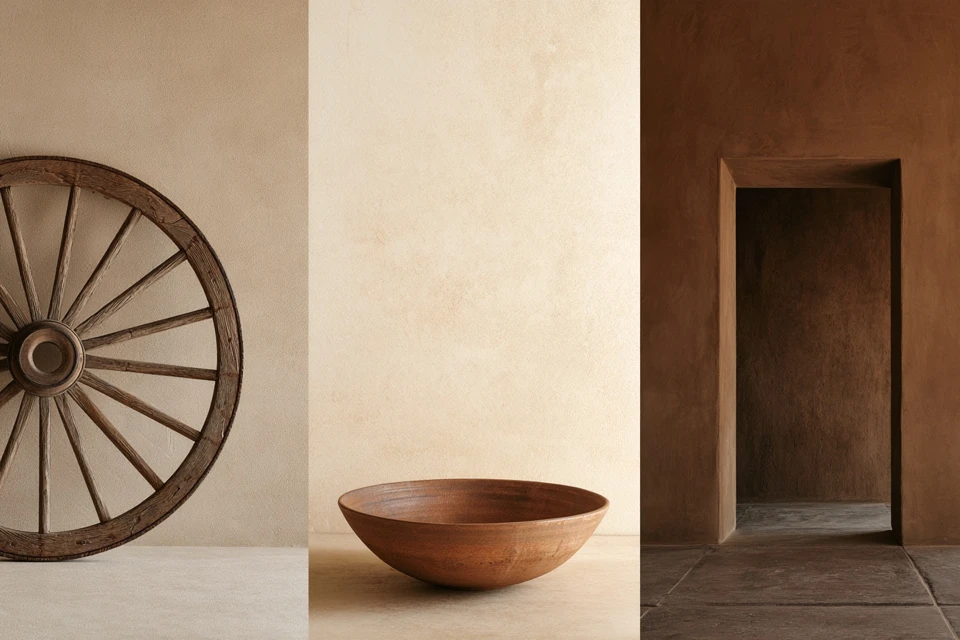
Working through it
- The gloss. The phrase 當其無, "at its nothing", appears three times with no change. The Chinese places the use at the empty part and doesn't say which empty part.
- Legge's brackets. Legge writes "(for the axle)" in the first sentence and "(within)" in the third. Both are additions that tell you where the emptiness is. In the second sentence he writes "their empty hollowness" with no brackets, so that phrase stands for 其無 by itself.
- The last line. The Chinese ends 故有之以為利,無之以為用: "so having it serves as benefit, not-having it serves as use". Legge gives "what has a (positive) existence serves for profitable adaptation, and what has not that for (actual) usefulness." He adds "(positive)" and "(actual)" and turns two one-character words into longer phrases.
Result
The chapter's argument (things are useful because of their empty parts) is fully in the Chinese. The precise locations, such as the axle, and the abstract nouns are Legge's. A modern version that talks about, say, the space inside you is making the same kind of move as Legge's brackets, only further from the text. Check it against the three columns and you'll see exactly where.
Common mistakes and limits
Treating the gloss as a translation
The gloss drops grammar, so it often looks stranger and more mystical than the Chinese reads to someone who knows the language. Use it to count words, not to read for meaning.
Assuming there is one Chinese text
The silk manuscripts found at Mawangdui in 1973 put the second half of the book (chapters 38 to 81) first, and the bamboo slips found at Guodian in 1993 contain only part of the text, in a different order. Even received texts differ: in chapter 25 the text shown here reads 人亦大 ("people too are great"), while Legge translated a version reading 王亦大 ("the king too is great").
Reading Legge's brackets as the original
Legge's brackets mark his additions openly. The words inside them are his choices and have no character behind them.

Modern translations can't be shown here because they are in copyright. Bring your own copy. Characters in the Chinese column are traditional; a simplified-character edition will look different but has the same text.
Questions about the reader
Why does this reader use Legge and not a modern translation?
Legge's translation was published in 1891 and is in the public domain, so it can be shown in full. Modern translations such as Mitchell's or Le Guin's are still in copyright. Keep your own copy open next to the reader and use the Chinese and gloss columns to check it.
Can I use the gloss column as a translation?
No. The gloss gives one or two English words per character in Chinese word order. It leaves out grammar, tense and the links between clauses, which is exactly the work a translator does. Use it to see which words are in the original.
Which Chinese text does the reader show?
A received (traditional) text in traditional characters, from Project Gutenberg eBook #7337. It is not always the text Legge translated from. In chapter 25, for example, this text has 人亦大 ("people too are great") where Legge's "the (sage) king is also great" follows the reading 王亦大.
Related pages
Sources
- James Legge, trans., The Tâo Teh King (1891), Project Gutenberg eBook #216.
- Chinese text: 道德經, Project Gutenberg eBook #7337.
- Word-by-word glosses for chapters 1 and 11 were written for this site.
- On the Mawangdui and Guodian manuscripts: Stanford Encyclopedia of Philosophy, "Laozi".