Free Online I Ching Generator & Coin Toss Divination Tool
Toss three coins six times and get your hexagram, its changing lines and the relating hexagram, in Legge's English beside the Chinese.
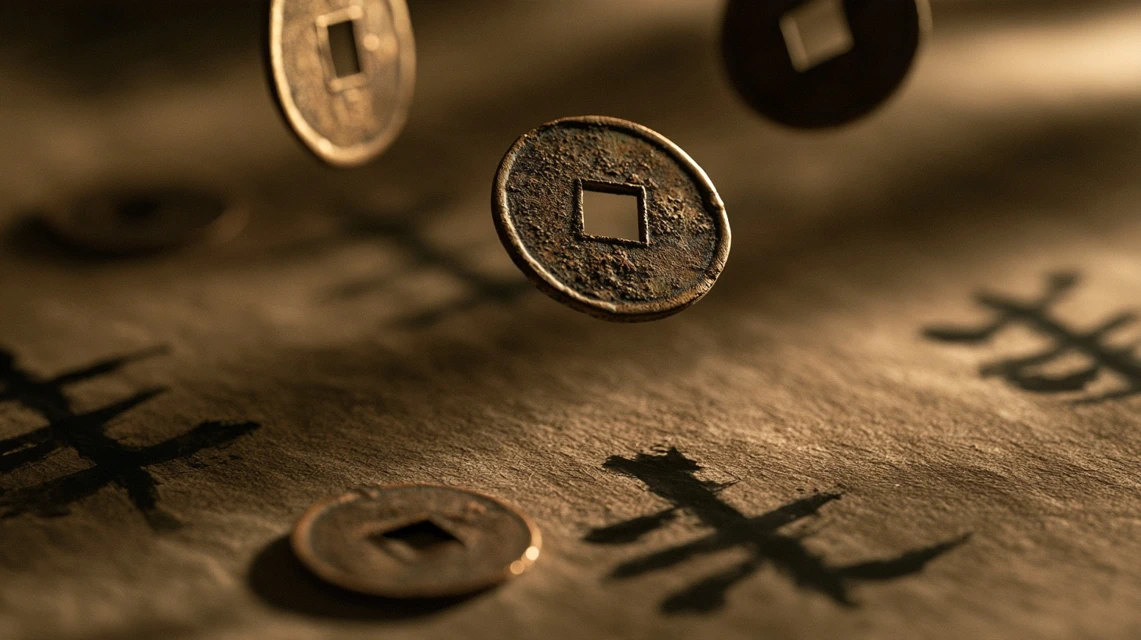

This generator uses the three-coin method. Each toss of three coins gives one line, starting from the bottom, and six lines make one of the 64 hexagrams. Lines that come out as 6 or 9 are changing lines: you read their line texts, and flipping them gives a second, relating hexagram.
Treat the result as a prompt for reflection. Nothing here predicts events, and the question you type never leaves your device.
Cast a hexagram
Stays in this box. It is not saved, sent anywhere or added to the page address.
Your reading appears here after the sixth line.
How the three-coin toss works
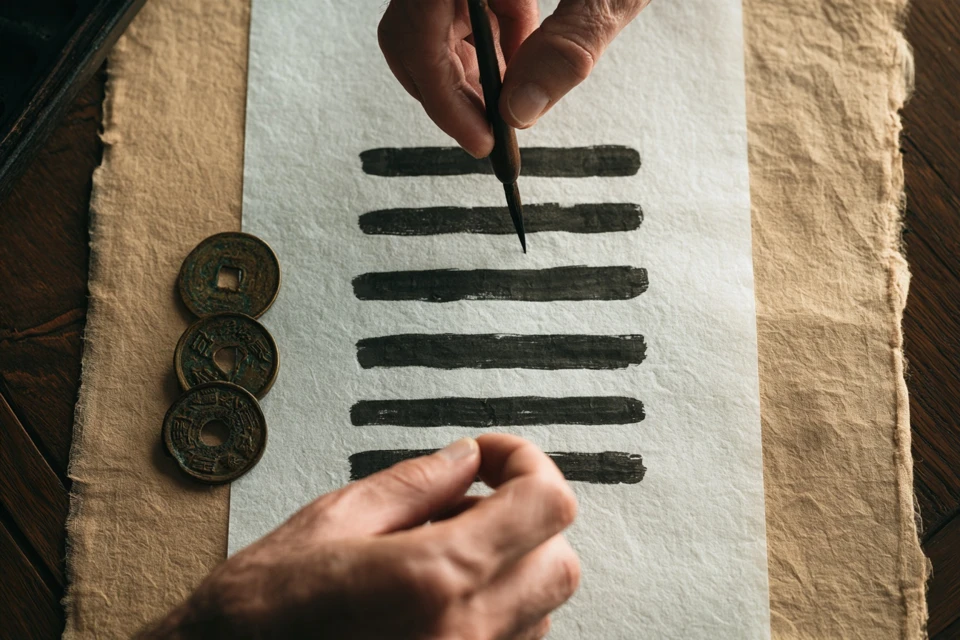
Heads count 3 and tails count 2. Add the three coins and the total, always between 6 and 9, tells you which line to draw. Three fair coins have eight equally likely outcomes, which gives the odds in the last column.
The lines are cast from the bottom up, so the first toss is the lowest line. The canvas in the tool builds the figure in that order and shows each coin.
| Total | Coins | Line | Changes? | Chance |
|---|---|---|---|---|
| 6 | tails, tails, tails | Old yin, broken | Yes, becomes solid | 1 in 8 |
| 7 | two tails, one heads | Young yang, solid | No | 3 in 8 |
| 8 | one tails, two heads | Young yin, broken | No | 3 in 8 |
| 9 | heads, heads, heads | Old yang, solid | Yes, becomes broken | 1 in 8 |
The older yarrow-stalk method, described in the Great Appendix (Legge's Appendix III), produces the same four values with different odds. This tool uses coins only.
Reading the primary hexagram
The reading panel shows the hexagram's number in the traditional King Wen order, its Chinese name with pinyin and a short English name, and its two trigrams. The lower trigram is lines 1 to 3 and the upper is lines 4 to 6.
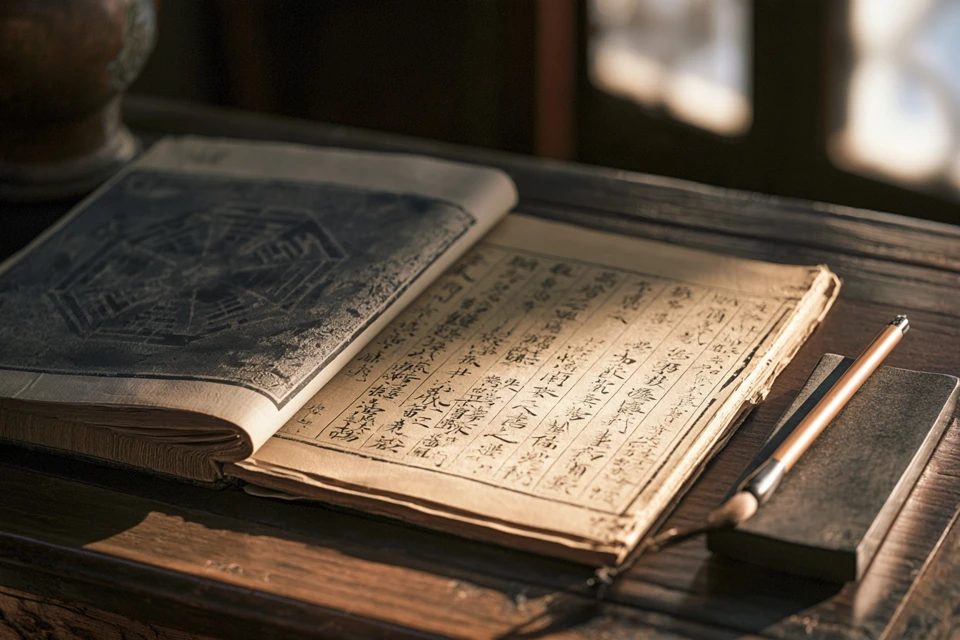
Below that is the judgment, the short text attached to the whole figure, in Legge's 1882 translation with the Chinese underneath. Legge uses his own romanisation for the names (for example "Khien" for Qián), so the first word of the judgment can look unfamiliar.
Changing lines and the relating hexagram
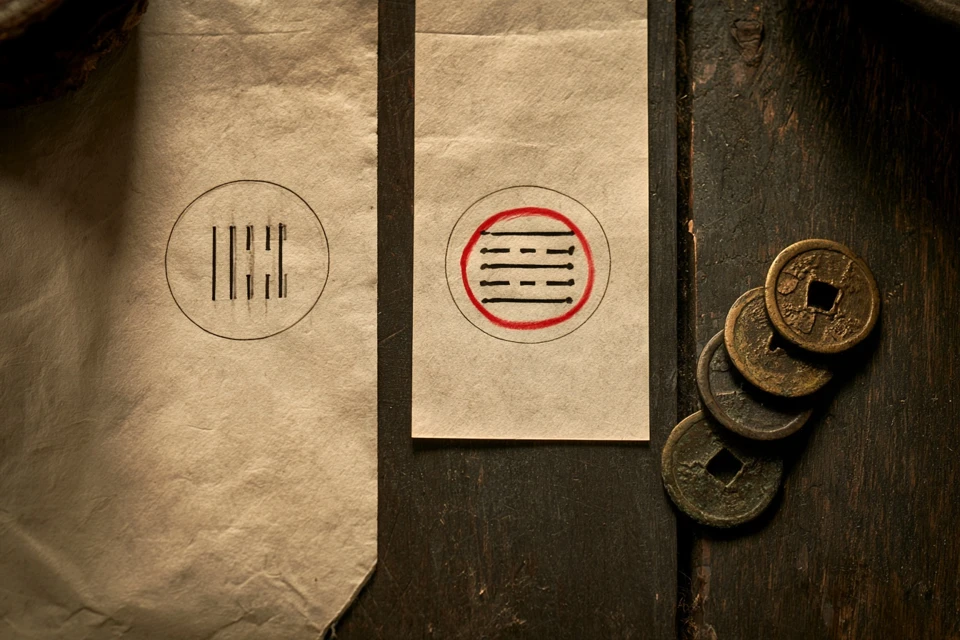
Each changing line has its own line text, which is usually read as more specific than the judgment. Flipping every changing line (solid to broken, broken to solid) gives the relating hexagram. The tool shows that panel only when at least one line changes.
Worked example
| Input | Six tosses, bottom to top, totalling 7, 8, 9, 7, 8, 8 |
|---|---|
| Lines | Solid, broken, solid (changing), solid, broken, broken. Lower trigram Lí (Fire), upper trigram Zhèn (Thunder). |
| Primary hexagram | 55, 豐 Fēng, Abundance. Legge's judgment: "Făng intimates progress and development. When a king has reached the point (which the name denotes) there is no occasion to be anxious (through fear of a change). Let him be as the sun at noon." |
| Changing line | The third line (a 9): "The third line, undivided, shows its subject with an (additional) screen of a large and thick banner, through which at midday he can see (the small) Mei star. (In the darkness) he breaks his right arm; but there will be no error." |
| Relating hexagram | Flipping the third line gives Zhèn over Zhèn: 51, 震 Zhèn, Thunder. |
You can reproduce this by hand with the coin table above. The tool gives the same result whenever the tosses come out this way.
How to use a reading, and when not to
Read the judgment first, then the changing lines, then the relating hexagram. Ask what the images suggest about your question rather than what they predict. Many readers write down the question, the hexagram numbers and a few lines of their own response, then come back to it later.
Don't use a reading in place of medical, legal or financial advice, or to make a decision that affects someone else's safety.
Questions about the I Ching coin toss
How does the 3-coin I Ching toss method work online?
Each toss uses three coins. Heads count 3 and tails count 2, so a toss totals 6, 7, 8 or 9. That total sets one line: 7 is a solid (yang) line, 8 a broken (yin) line, and 6 and 9 are the same lines in a changing state. You toss six times and build the hexagram from the bottom up. This page uses your browser's cryptographic random number generator for each coin.
What are changing lines (old yin and old yang) in an I Ching reading?
A 6 is old yin and a 9 is old yang. Both are read as lines about to turn into their opposite. In a reading they do two things: you read the line text for each changing line, and you flip those lines to get a second figure, the relating hexagram. With the coin method each line has a 1 in 8 chance of being a 6 and a 1 in 8 chance of being a 9.
How do I interpret the primary hexagram and the relating hexagram?
Start with the primary hexagram's judgment, which sets the overall situation. Then read the changing line texts, which are more specific. The relating hexagram, made by flipping the changing lines, is usually read as where the situation is heading. If no lines change, there is no relating hexagram and the judgment stands on its own. Use the texts as prompts for thinking, not as predictions.
Keep reading
The I Ching and the Tao Te Ching share a vocabulary of change, yin and yang. Read the guide to Taoism basic beliefs, or go back to the Tao Te Ching best translation guide and compare chapters side by side.
Sources
- James Legge, trans., The Yî King, in The Sacred Books of the East, vol. 16 (Oxford: Clarendon Press, 1882). Hexagrams 1 to 32 from the proofread Wikisource transcription; hexagrams 33 to 64 from the Internet Archive scan of the same volume, corrected by hand against a second scan.
- Chinese text: 易經, Project Gutenberg eBook #25501. Line types (九 for yang, 六 for yin) are read from this text.
- Coin probabilities are computed from the eight equally likely outcomes of three fair coins (see the table on this page).